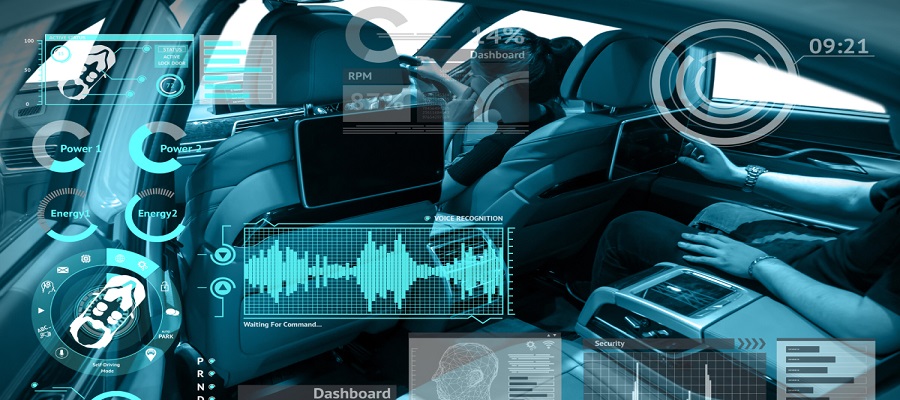

The automotive industry has witnessed significant technological advancements aimed at improving vehicle performance, safety, and entertainment options. Modern vehicles now come equipped with advanced driver-assistance systems (ADAS) such as adaptive cruise control, collision warning systems, automatic emergency braking systems, and advanced infotainment systems, among others. These systems rely on embedded systems with advanced microcontrollers that communicate with each other to ensure seamless operation.

Traditionally, vehicles have used the Controller Area Network (CAN) bus to facilitate communication between embedded systems without the need for a host computer. However, the limitations of CAN, with its maximum data transmission rate of 1 Mb/s (and 8 Mb/s for CAN-FD), have become evident in the face of the increasing data requirements of today’s embedded systems. For instance, the data generated by sensors for collision avoidance, such as cameras, radar, and LiDAR, far exceeds the bandwidth capacity of the CAN bus. A single LiDAR sensor alone can produce a data stream of up to 70 Mb/s.
To overcome these limitations, the automotive industry has turned to Ethernet as a replacement for CAN in handling in-vehicle communication. Automotive Ethernet (AE) provides a higher baud rate, enabling the transfer of large data throughput. It offers data transfer speeds of around a gigabit per second and supports various versions, including IEEE 802.3cg, which specifies up to 10 Mb/s, and 802.3ch, which specifies 2.5, 5, and 10 Gb/s. AE utilizes twisted-pair cables or fibre optics for signal integrity and noise resistance.
While automotive Ethernet presents a promising solution, it also comes with its challenges. The industry faces the task of maintaining multi-gigabit data transmission within vehicles in the near term while aiming for even higher throughput in the future. Ensuring electromagnetic compatibility and reliability in increasingly noisy environments, as well as managing the weight and costs associated with wire harnesses, are additional concerns.
To address these challenges, new IEEE automotive Ethernet standards are emerging, including 10BASE-T1S. This standard, specified in IEEE 802.3cg, provides a physical layer and data link layer for MAC addresses within Ethernet networks. It supports a maximum transmission speed of 10 Mb/s, utilizes single twisted-pair cabling, and enables multi-drop transmission at distances of 25 meters or more. The inclusion of a physical-layer collision-avoidance ability prevents data traffic congestion and maximizes throughput efficiency.
The 10BASE-T1S standard eliminates the need for gateways to connect incompatible communication or embedded systems, thereby increasing scalability and data throughput. It also offers power over the network, reducing cable requirements, shrinking connector sizes, and enhancing system reliability. With the implementation of 10BASE-T1S, automotive Ethernet can expand and evolve alongside embedded electronics, enabling the development of new feature sets, low latencies, and efficient bandwidth utilization in vehicle electrical/electronic (E/E) systems.
Automotive suppliers have already begun producing 10BASE-T1S components, and system designs are underway to incorporate these devices. The standard also facilitates Ethernet-to-the-edge connectivity, optimizing connections such as telematics control units (TCUs) that handle wireless connectivity for various applications. However, challenges remain, including addressing the potential increase in cost and complexity when designing embedded systems and devices. Suppliers are collaborating with original equipment manufacturers (OEMs) to ensure system requirements are met before market implementation of the 10BASE-T1S standard.